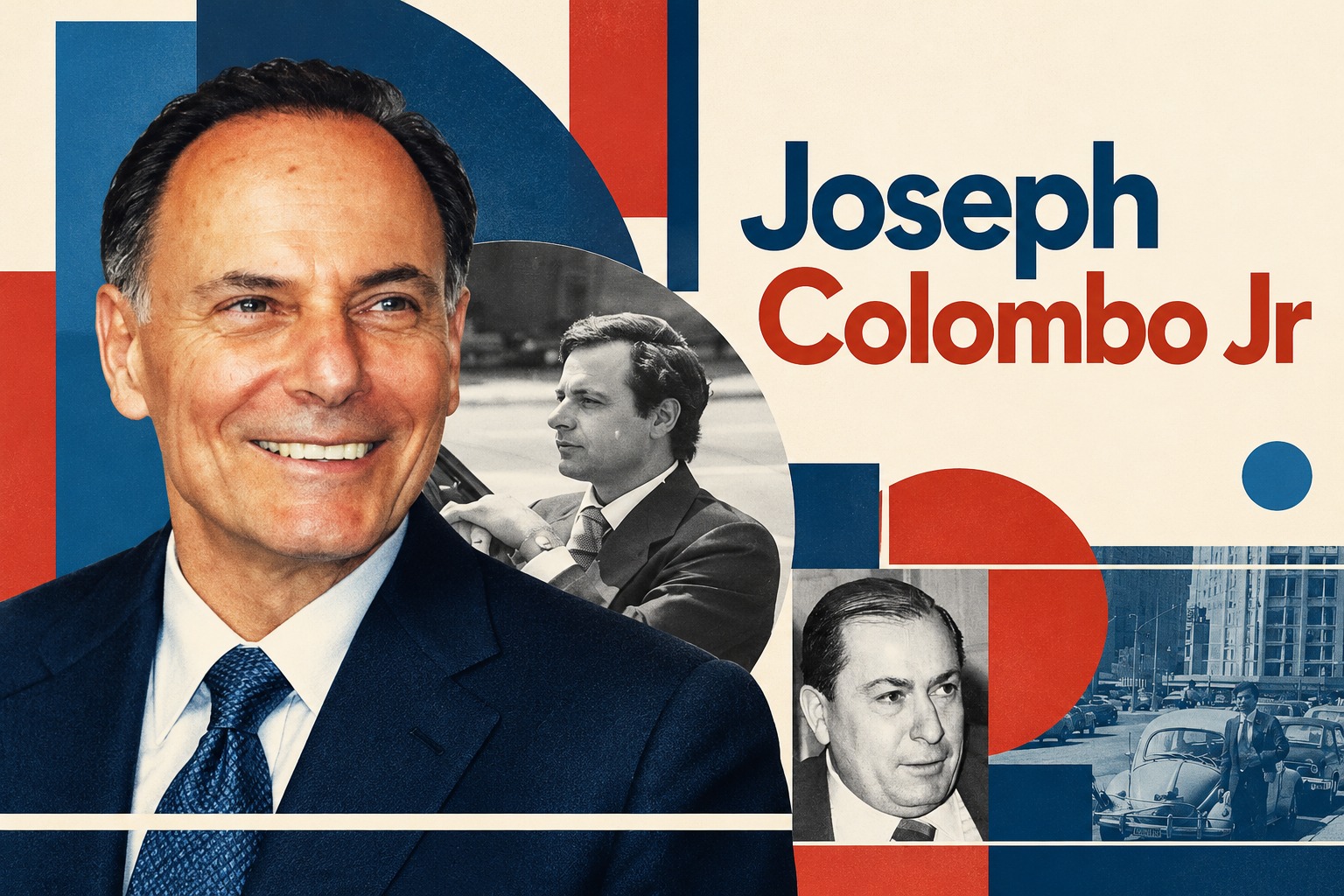
Joseph Colombo Jr is often encountered through the history of his father, Joseph Anthony Colombo Sr. I find the distinction between the two men essential. The elder Colombo was the New York crime boss and founder of the Italian American Civil Rights League. His son became widely discussed because of a federal case that helped spur the elder man’s protests. Sharing a name did not mean sharing every role.
Joseph Anthony Colombo Jr was born on December 24, 1946, and died on October 29, 2014, in Newburgh, New York, at 67. His public profile is concentrated around events in 1970 and 1971. Later family details appear mainly in the account of his wife and children, rather than a sustained public career biography.
Joseph and Lucille’s Son
His parents were Joseph Colombo Sr and Lucille Faiello Colombo. Joseph Sr was born in 1923 and died in 1978. The younger Joseph grew up within a household whose father’s criminal leadership eventually made its surname nationally recognizable.
His brothers included Anthony Edward Colombo, Christopher Colombo, and Vincent Colombo. Anthony, born in 1945, was the eldest son and died in 2017. Christopher later spoke publicly about their father and family history. Vincent appears less frequently in those public accounts, but is named among the siblings.
The elder Colombo is generally described as having five children. The supplied account does not consistently name the fifth child. The known brothers can be introduced clearly while leaving an incomplete naming record incomplete.
The Case in April 1970
In April 1970, Joseph Jr was charged in connection with an alleged scheme to melt silver coins and sell the metal. The value of the coins varies across retellings, so an exact amount is less dependable than the nature of the allegation. The charge was a specific federal prosecution, not a verdict establishing that the scheme occurred as alleged.
Joseph Sr reacted with demonstrations against the FBI. The case became a major spur to the formation and visibility of the Italian American Civil Rights League. I see that sequence as the reason the son’s prosecution acquired significance beyond its own courtroom: it intersected with the father’s campaign and the wider public argument he advanced about the treatment of Italian Americans.
The league’s activities belonged principally to Joseph Sr’s public role. It would be inaccurate to describe Joseph Jr as its founder simply because his indictment helped provoke those activities. He was the defendant at the center of the immediate dispute, while his father organized the protests surrounding it.
Acquittal in February 1971
Joseph Jr was acquitted in February 1971. Accounts describe the prosecution’s chief witness being arrested on perjury charges as the case faltered. The acquittal is the legal outcome that must accompany any mention of the earlier indictment.
An arrest is an allegation, rather than a finding of guilt. Equally, the acquittal does not establish a complete biography of everything the younger Colombo did. It settles the outcome of this particular prosecution, which is the most clearly described legal episode connected with him in the supplied material.
The chronology is compact but consequential: charges in April 1970, public protests, then acquittal in February 1971. Within less than a year, a son’s federal case had become part of a much larger family and political spectacle. The distinction between legal proceedings and public campaigning gives each event its proper scale.
The Shooting of Joseph Colombo Sr
On June 28, 1971, the elder Colombo was shot at an Italian Unity Day rally. The attack left him paralyzed and removed him from active public life. He died in 1978. These events are central to the father’s biography and to the family’s history after the son’s acquittal.
They should not be transferred to Joseph Jr, who was a different man. I find the shared name creates an especially easy shortcut for confusion: the defendant, the league organizer, and the shooting victim can become one figure in a hurried retelling. In fact, the defendant was the son, while the public organizer and later victim was his father.
Christopher’s later interviews return to this period, giving another son’s perspective on the family. Those recollections are part of Christopher’s public activity, not statements made by Joseph Jr. Keeping the speaker clear prevents later family commentary from becoming an invented interview with a man who died in 2014.
Diane and Their Children
Joseph Jr’s wife was Diane. His surviving children were identified as Dina, Denise, and Joe, also called Joseph. Their names provide the clearest outline of his own adult household. They belong to a different generation from his brothers Anthony, Christopher, and Vincent.
Joe, the son, also carries the recurring family name. He should not be confused with either Joseph Jr or Joseph Sr. The three generational positions are straightforward when stated plainly: Joseph Sr was the father, Joseph Jr his son, and the younger Joe was Joseph Jr’s son.
No verified personal net worth or detailed later employment history is established for Joseph Jr. His father’s influence and the notoriety of the Colombo crime family do not supply that information. The criminal organization and the biological family are overlapping subjects in public history, but they are not identical lists of people.
FAQ
Was Joseph Colombo Jr the boss of the Colombo crime family?
The widely known boss discussed in this account was his father, Joseph Anthony Colombo Sr. Joseph Jr is chiefly recognized through his 1970 federal prosecution and its connection with his father’s protests.
What happened in Joseph Colombo Jr’s coin case?
He was charged in April 1970 over an alleged silver coin melting scheme and was acquitted in February 1971. The prosecution faltered after its chief witness was arrested on perjury charges.
Who were Joseph Colombo Jr’s wife and children?
His wife was Diane, and his children were Dina, Denise, and Joe. He died in Newburgh, New York, on October 29, 2014, at the age of 67.


